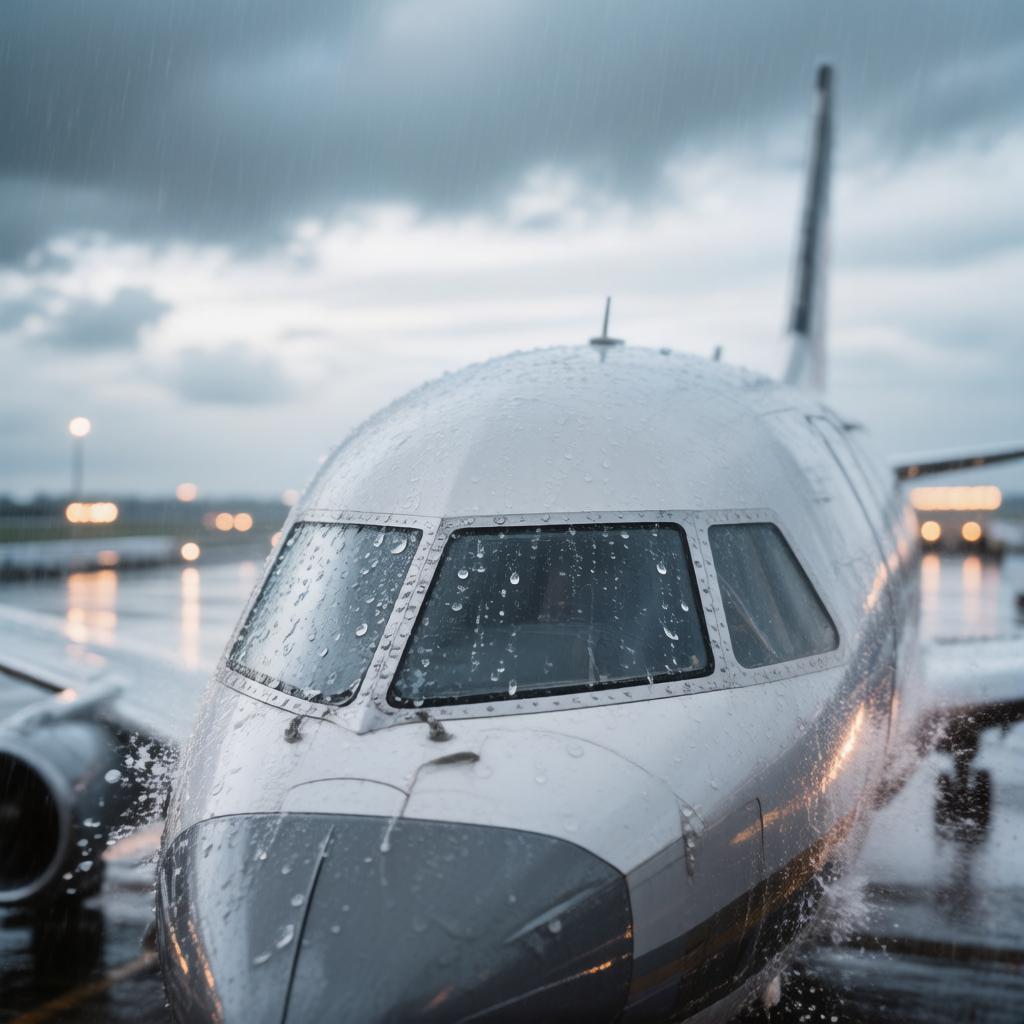
Yes, planes can take off, land, and fly in rain. Light or moderate rain by itself normally does not stop commercial airline operations. What matters is whether the overall weather remains within safe operating limits.
Heavy rain can reduce visibility and leave water on the runway, while thunderstorms can bring much more serious hazards such as wind shear, microbursts, turbulence, hail, lightning, and rapidly changing winds. That is why a flight may operate normally during steady rain but be delayed when thunderstorms are near the airport.
Pilots, airlines, airports, and air traffic control consider the complete weather picture rather than deciding whether a flight can leave based only on whether it is raining.
Can Planes Fly in Different Types of Rain?
| Weather | Can Planes Usually Fly? | Main Concern |
|---|---|---|
| Light rain | Yes | Usually minimal |
| Moderate rain | Usually yes | Visibility and runway conditions |
| Heavy rain | Depends | Visibility, standing water, braking |
| Rain with strong winds | Depends | Crosswinds and gusts |
| Rain with thunderstorms | Flights may be delayed or rerouted | Wind shear, turbulence, lightning, hail |
| Heavy rain with poor visibility | Depends on operating minima | Visibility |
| Standing water on runway | Requires additional assessment | Braking and hydroplaning |
There is no simple rule that “rain means no flying.” The intensity of the rain and the weather around it matter much more.
Can Planes Fly in Rain?
Yes.
Commercial airplanes routinely operate in drizzle, light rain, moderate rain, and in some situations even heavy rain.
Rain is treated as one part of the overall weather picture. Pilots and dispatchers also consider:
- visibility;
- wind speed and direction;
- runway condition;
- standing water;
- thunderstorms;
- aircraft performance;
- airport operating conditions.
The presence of rain alone does not mean that an airplane must remain on the ground.
The FAA classifies precipitation intensity as light, moderate, or heavy and evaluates it along with visibility, winds, and other weather information. The FAA Aeronautical Information Manual describes these weather factors and the hazards associated with convective activity.
Can Planes Take Off in Rain?
Yes, airplanes can take off in rain and from wet runways.
Before takeoff, however, the crew must consider whether the runway and weather conditions allow the aircraft to meet the required performance limits.
Factors may include:
- aircraft weight;
- runway length;
- runway surface condition;
- wind;
- visibility;
- standing water;
- expected braking performance.
A runway does not automatically become unusable simply because it is wet.
If conditions remain within the required limits, takeoff can proceed normally. If the runway is heavily contaminated with water or other conditions make performance unacceptable, the departure may be delayed or another runway may be used.
Does a Wet Runway Make Takeoff More Difficult?
A wet runway can affect aircraft performance calculations.
Water reduces tire-to-pavement friction, which becomes especially important during braking.
This matters during situations such as:
- a rejected takeoff;
- landing rollout;
- strong crosswinds;
- significant standing water.
Airports monitor and report runway conditions so flight crews can account for them.
The FAA’s Takeoff and Landing Performance Assessment guidance explains how runway surface conditions are assessed and communicated for aircraft performance purposes.
A wet runway is therefore not automatically unsafe, but it requires the conditions to be evaluated properly.
Can Planes Land in Rain?
Yes. Rain by itself does not normally prevent an aircraft from landing.
Landing becomes more complicated when rain is combined with other limiting conditions.
Important factors include:
- visibility;
- cloud ceiling;
- wind;
- runway condition;
- braking performance;
- standing water;
- thunderstorms near the airport.
If the weather does not meet the requirements for the planned approach, the aircraft may need to wait, try again later, or divert to another airport.
Pilots do not decide whether to land simply by looking at how hard it appears to be raining. They use reported weather, runway information, aircraft performance data, and the applicable operating limits.
Can Planes Fly in Heavy Rain?
Sometimes.
Heavy rain is more operationally significant than light or moderate rain because it can create several additional problems.
It may:
- sharply reduce visibility;
- create standing water;
- reduce runway braking performance;
- occur with strong or gusty winds;
- be associated with thunderstorms.
Heavy rain therefore has a greater chance of causing delays or restrictions, but there is no rule that every aircraft must stop flying as soon as rain becomes heavy.
The full weather situation matters.
How Does Rain Affect Visibility?
Heavy rain can significantly reduce visibility.
In aviation, the important question is not whether a passenger can clearly see the ground from the window. What matters is whether the reported visibility and other conditions meet the requirements for the operation being performed.
Reduced visibility can affect:
- departures;
- approaches;
- landing;
- airport traffic flow.
Some airports and aircraft can operate in relatively poor visibility under the appropriate procedures, but there is no single visibility threshold that applies to every airplane and every airport.
Why Are Thunderstorms More Important Than Rain?
Ordinary rain and thunderstorms are not the same thing.
A thunderstorm can contain several serious aviation hazards at the same time:
- severe turbulence;
- wind shear;
- microbursts;
- lightning;
- hail;
- strong updrafts;
- downdrafts;
- rapidly changing winds;
- very intense precipitation.
This is why a flight may continue normally in steady rain but be delayed when thunderstorms move into the area.
Airliners generally avoid hazardous thunderstorm cells rather than flying directly through them.
Can Planes Fly Through Thunderstorms?
Airliners generally avoid the dangerous parts of thunderstorms.
Pilots and air traffic control may:
- reroute aircraft around storm cells;
- delay departures;
- hold arriving aircraft;
- change arrival and departure routes.
An airplane may still fly in a region where thunderstorms are present, but its route may be altered to stay away from the hazardous areas.
The main issue is not simply the rain inside the storm. Thunderstorms can produce extreme air movement, wind shear, hail, and other conditions that make avoidance the safer strategy.
Why Can a Flight Be Delayed When It Is Only Raining at the Airport?
A passenger may look out of the terminal window, see ordinary rain, and wonder why the flight is delayed.
The reason may be many miles away.
For example:
- thunderstorms may block the normal departure route;
- arrivals may need to be rerouted;
- air traffic controllers may have fewer usable routes;
- the incoming aircraft may be delayed at another airport;
- storm cells may reduce the amount of usable airspace.
According to the FAA weather delay guidance, severe weather can reduce airport and airspace capacity even when conditions directly over the terminal do not look especially dramatic.
A weather delay therefore does not necessarily mean the weather directly above the airport is unsafe.
Does Rain Cause Flight Delays?
Yes, rain can contribute to flight delays.
However, the more accurate explanation is that rain and the weather system associated with it can affect operations.
Potential reasons include:
- reduced visibility;
- wet or contaminated runways;
- strong winds;
- low clouds;
- thunderstorms;
- rerouting around bad weather;
- reduced airport capacity.
Light steady rain may have little effect on a schedule.
A line of thunderstorms, on the other hand, can create major delays across an entire region.
Can Rain Cause a Flight to Be Canceled?
Yes, in some situations.
Light rain by itself rarely means that a commercial flight will automatically be canceled.
Cancellation becomes more likely when weather creates broader operational problems, such as:
- persistent severe thunderstorms;
- flooding;
- unusable runway conditions;
- very strong winds;
- prolonged poor visibility;
- widespread air traffic disruption.
Weather may also cause aircraft and crews to be out of position, which can create later cancellations even after conditions at the departure airport improve.
What Happens When Thunderstorms Are Near an Airport?
Thunderstorms can reduce how many airplanes an airport can safely handle at once.
Arrivals may slow down
Aircraft may be placed in holding patterns or given longer routes.
Departures may be reduced
Air traffic control may limit departures because fewer safe routes are available.
Aircraft may be rerouted
Flights may have to travel around thunderstorm cells instead of following their normal route.
Delays can spread
When arriving aircraft are late, gates remain occupied longer and departing flights may also be delayed.
A storm affecting one part of the air traffic system can therefore create delays far from the storm itself.
What Is Wind Shear?
Wind shear is a rapid change in wind speed, wind direction, or both.
It is particularly important close to the ground during takeoff and landing.
Thunderstorms can produce strong low-level wind shear, which is one reason crews avoid operating too close to dangerous storm activity.
What Is a Microburst?
A microburst is a strong, localized downdraft that spreads outward when it reaches the surface.
It can create sudden changes in wind speed and direction.
Microbursts are especially dangerous near takeoff and landing because the aircraft is close to the ground and has less time and altitude to respond to rapid changes in airflow.
Not every rain shower contains a microburst.
Does Rain Cause Turbulence?
Rain itself is not necessarily the cause of turbulence.
Turbulence is primarily related to movement of the surrounding air.
However, intense precipitation is often associated with convective weather, including thunderstorms, where strong turbulence may occur.
This is why flying through ordinary steady rain can feel completely smooth, while flying near a strong storm system may be much more turbulent.
Raindrops hitting the airplane are not what create most aviation turbulence.
What About Lightning?
Lightning is commonly associated with thunderstorms.
Commercial aircraft are designed with lightning protection in mind and can withstand lightning strikes under the applicable certification requirements.
However, that does not mean pilots intentionally fly through thunderstorms.
Lightning is only one of several hazards associated with storms. Turbulence, hail, wind shear, microbursts, and rapidly changing winds can be more operationally significant.
Can a Plane Hydroplane on a Wet Runway?
Yes, hydroplaning is a real aviation concern.
Hydroplaning occurs when a tire partially or completely loses normal contact with the pavement because of a layer of water.
This can reduce:
- friction;
- braking effectiveness;
- directional control.
The risk becomes more significant with substantial standing water and higher speeds.
That does not mean airplanes hydroplane every time they use a wet runway. Runway condition and aircraft performance are evaluated before takeoff and landing.
How Do Airports Handle Wet Runways?
Airports monitor and report runway surface conditions.
Crews then consider information such as:
- runway condition;
- aircraft weight;
- available runway length;
- wind;
- braking performance.
This allows the flight crew to determine whether the aircraft can safely take off or land under the existing conditions.
If the runway condition is not suitable, operations may be restricted until conditions improve.
Is Flying in Rain Safe?
Rain by itself is a normal weather condition that commercial aviation is prepared to operate in, provided all operating and weather requirements are met.
That does not mean every situation involving rain is automatically safe.
Pilots and airlines evaluate the full weather picture, including:
- visibility;
- wind;
- runway condition;
- thunderstorms;
- aircraft performance.
A flight proceeds only when those factors remain within the applicable limits.
What Weather Actually Stops a Flight?
There is no single weather number that automatically stops every airplane.
Operations may be restricted by:
- severe thunderstorms;
- extreme winds;
- wind shear;
- microbursts;
- very poor visibility;
- flooding;
- unsafe runway conditions;
- severe icing;
- other hazardous weather.
The actual limits depend on the aircraft, airport, runway, operator, and type of operation.
That is why one flight may depart while another is delayed during apparently similar weather.
Rain vs Other Weather Hazards
| Condition | Typical Effect |
|---|---|
| Light rain | Flights usually continue |
| Moderate rain | Usually manageable |
| Heavy rain | May reduce visibility and runway performance |
| Wet runway | Requires performance and braking consideration |
| Standing water | Greater braking and hydroplaning concern |
| Thunderstorm | Aircraft generally avoid hazardous cells |
| Wind shear | Major concern near takeoff and landing |
| Microburst | Potentially hazardous near the ground |
| Strong crosswind | Can limit runway operations |
| Low visibility | May restrict approaches and departures |
Will My Flight Be Delayed If Rain Is Forecast?
Not necessarily.
Rain in the forecast does not automatically mean a delay.
The effect depends on:
- how heavy the rain becomes;
- whether thunderstorms develop;
- wind conditions;
- visibility;
- runway conditions;
- airport capacity;
- weather along the route;
- how long the system lasts.
A day of light steady rain may have very little effect on flight schedules.
A short but intense thunderstorm line can create major disruption.
Should Passengers Worry When It Rains Before Takeoff?
Seeing rain on the airplane window does not by itself mean conditions are unsafe.
Flight crews receive detailed information about the weather, wind, runway, and aircraft performance before departure.
If the conditions are not suitable for a safe takeoff, the aircraft will wait, use another available option, or the flight may eventually be canceled.
Planes routinely take off, land, and fly in rain, so seeing rain at the airport does not automatically mean your flight will be delayed or canceled. The bigger concerns are the conditions that may come with heavier weather, including poor visibility, standing water on the runway, strong winds, wind shear, microbursts, and thunderstorms. A wet runway can require different performance calculations, while dangerous storm cells may force aircraft to wait or fly around them. Ultimately, airlines and pilots base the decision on the complete weather and runway conditions rather than on the presence of rain alone.